
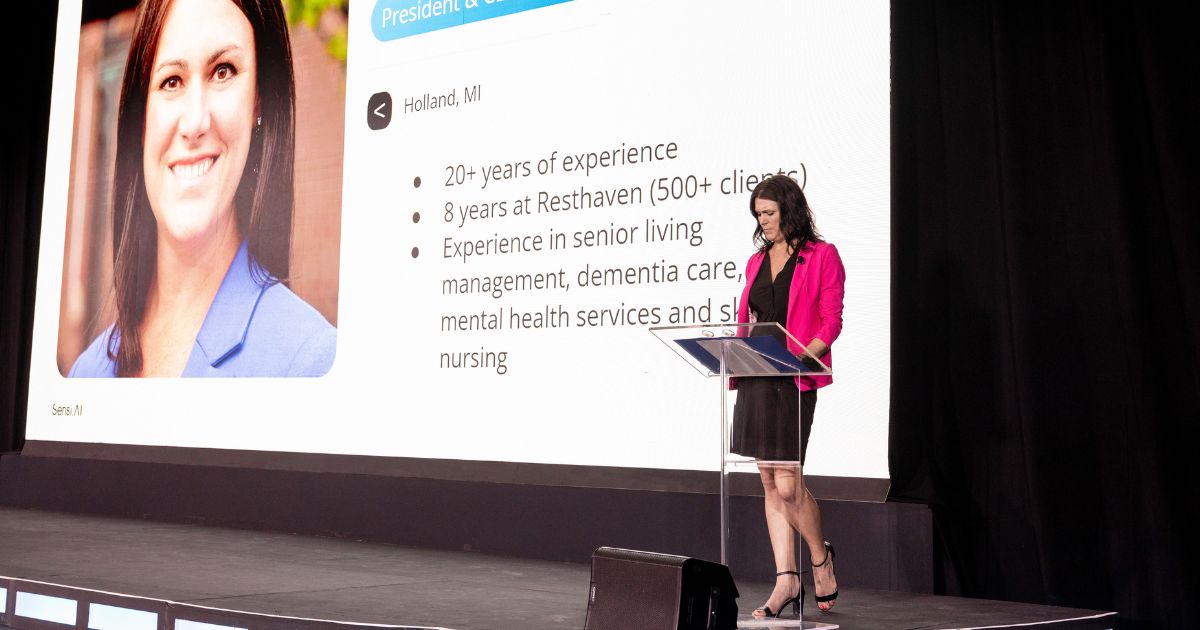
Resthaven is a 81-year-old faith-based nonprofit senior living organization in Holland, Michigan. It operates across the full care continuum: assisted living, independent living, and skilled nursing.
President and CEO of Resthaven Deedre Schuckert starts every board meeting with one question: What is the biggest risk our industry faces right now?
You might be surprised to learn, Deedre doesn’t think the biggest risk to the senior living industry is staffing shortages, regulatory compliance, or funding pressures, though those things are on the mind of every care leader.
The biggest risk, Deedre told an audience at a Sensi event, is doing nothing at all. “Quite truly,” she said, “if we don’t take risks, we’re done anyway.”
A sector at a crossroads
“Our goal is to make people’s retirement years the best they can be, regardless of what cognitive or physical or mental or medical issues may arise.”
Given the clients, senior care is designed to be cautious. In 2023, nursing homes became the most regulated industry in the US, surpassing nuclear power plants. The need for guardrails should be accepted as fact and not used as an excuse for less innovation.
“Our goal is to make people’s retirement years the best they can be, regardless of what cognitive or physical or mental or medical issues may arise.”
If community executives focus on compliance it can be difficult to see it as anything but an end goal, instead of a bare minimum. There’s an opportunity for leaders to use the constraint of compliance to push for ambitious and creative strategies that offer the very best care to older adults. Aim high to protect your clients, but consider what else you can offer them beyond what is required?
“That is what we have been doing in senior living for decades,” she said, describing a job candidate who answered every question about their first 90 days with talk of policies and regulatory compliance. “And we have one of the worst products from a customer standpoint.”
Pressures are severe. The direct care workforce shortage is projected to reach 3.2 million workers by 2040. Turnover in long-term care runs between 75 and 79% annually. And one in five seniors who fall sustains a serious injury, a stat that underscores how much is at stake when early warning signs go undetected.
While those stats describe an industry that may be facing a crisis, senior living can be distilled into a goal to provide a good life to to elders. Deedre never forgets her North Star: “Our goal is to make people’s retirement years the best they can be, regardless of what cognitive or physical or mental or medical issues may arise.”
No matter what you add to your community workflow, whether that’s technology, staffing models, building or interior design, all of it is so you can deliver superior care.
Start with the person, not the regulation
“Instead of starting with the person and what their needs are, and then figuring out how to meet those within whatever restrictions we may have.”
Resthaven has two core values that anchor its work. The first is: know my name. And, what that means is, get to know who the client is beyond their diagnosis or age or any clinical description. The second is: walk with me. A request that touches on the client and caregiver relationship. It’s a short request that asks for a relationship that goes beyond managing care needs to accompanying residents through their lives.
“This is an industry where we tend to start with the regs and then build programs around them,” Deedre says in a Sensi spotlight, “instead of starting with the person and what their needs are, and then figuring out how to meet those within whatever restrictions we may have.”
This client-centered point of view shapes how Resthaven evaluates technology. Each new tool or workflow needs to pass the litmus of helping staff serve each resident better.
“We now will have not just the 5-minute observations, three times an hour, three times a day,” she said, “but we’ll be able to capture more holistically the whole person—not just based on maybe my implicit bias, or stereotypes, or assumptions. Now we can really know that we’re being specific to the person, that we’re looking at them as an individual.”
What Sensi looks like in practice
When Resthaven deployed approximately 45 Sensi devices across its assisted living and skilled nursing communities in 2025, the organization saw results in ways both anticipated and unexpected. One shift is in how the Resthaven team uses evidence. They are moving away from relying on resident recall and staff observation toward objective, audio-based care intelligence documentation. Their team noticed that what Sensi captures is frequently absent from clinical charts, so they now conduct internal audits to close the gap between what is reported in clinical charts and what Sensi surfaces.
Detecting end-of-life changes before clinical confirmation. Shortly after deployment, a staff member reviewed the Sensi feed called Deedre before a board member’s Christmas party: his mother-in-law, a Resthaven resident, was showing acute changes. Hours later, the nursing home administrator independently reached the same conclusion after speaking with hospice. “It helped me be there empathically for the board member where I may not have known otherwise,” Deedre said. The signal from Sensi, hospice, and the care staff had aligned.
Uncovering root causes behind repeated calls for help. One resident’s calls for help clustered consistently between 3 and 5 p.m. Sensi’s continuous audio care intelligence surfaced the pattern. Resthaven’s care team investigated, identified a fear of incontinence as the root cause, and posted a bathroom schedule on a whiteboard. A decrease in calls followed. What seems like a small intervention had an outsized impact on the client’s daily life.
Supporting residents in isolation. A typically social resident placed under infection control precautions began talking to herself in her room, a shift that staff would not otherwise have detected. Sensi surfaced the mood-related changes. To address, care staff added 1-to-1 visits and individualized activities during the hours of most distress. The care intelligence platform has since detected 50% fewer distress signals than before the intervention.
Sensi was built from the ground up to deliver these types of outcomes. The platform operates continuously to capture 100+ care insights and deliver them to care teams as actionable alerts and structured reports. It’s a clinical layer that works with caregivers to provide superior care to enhance the quality of life for seniors.
For residential communities, avoidable hospitalizations affect the mental, physical, and emotional health of residents, overhead costs, CMS star ratings, and referral relationships. Other Sensi customers have documented approximately 22% percent fewer hospitalizations.
We must try new things
“We must do something. We must try new things. No one else is solving this. It is up to us.”
Deedre knows things will stay the same, if changes aren’t made to the operational layer of how senior care communities are run. She would know, since she became CEO Resthaven went through an $80 million expansion, a global pandemic, and the near-complete turnover of an executive team. While some of this disruption was out of her control, in aggregate all these changes tested Deedre’s leadership clarity, forced Resthaven to rebuild smarter, and allowed the team to emerge with operational resilience. She says, “We must do something. We must try new things. No one else is solving this. It is up to us.
Not changing your workflows and processes is itself a risk. Senior care communities know their KPIs: reducing hospitalizations and supporting the mental, emotional, and physical health of residents. Achieving better outcomes on those metrics requires a different strategy for how care is actually delivered. Resthaven partnered with Sensi to do something different and it’s netting a better standard of care. Don’t you owe the best experience to the seniors in your care?
Want to see how Sensi can help you provide a better experience for residents at your senior living community? Book a demo.
FAQ
Sensi deploys audio AI pods in resident rooms that use care intelligence to detect 100+ care insights. This includes falls, respiratory changes, behavioral shifts, and emotional wellbeing indicators. The platform delivers real-time alerts to care staff and structured care reports, without requiring any action from residents.
Sensi customers have reported approximately fewer hospitalizations and early detection of conditions including UTIs, pneumonia, pain patterns, and behavioral decline. At Resthaven, deployment identified end-of-life changes, root causes of repeated calls for help, and mood shifts in residents.
Sensi is HIPAA-compliant, captures only care-relevant events, and uses no cameras. Audio AI pods are passive and unobtrusive, consistent with resident dignity.
