
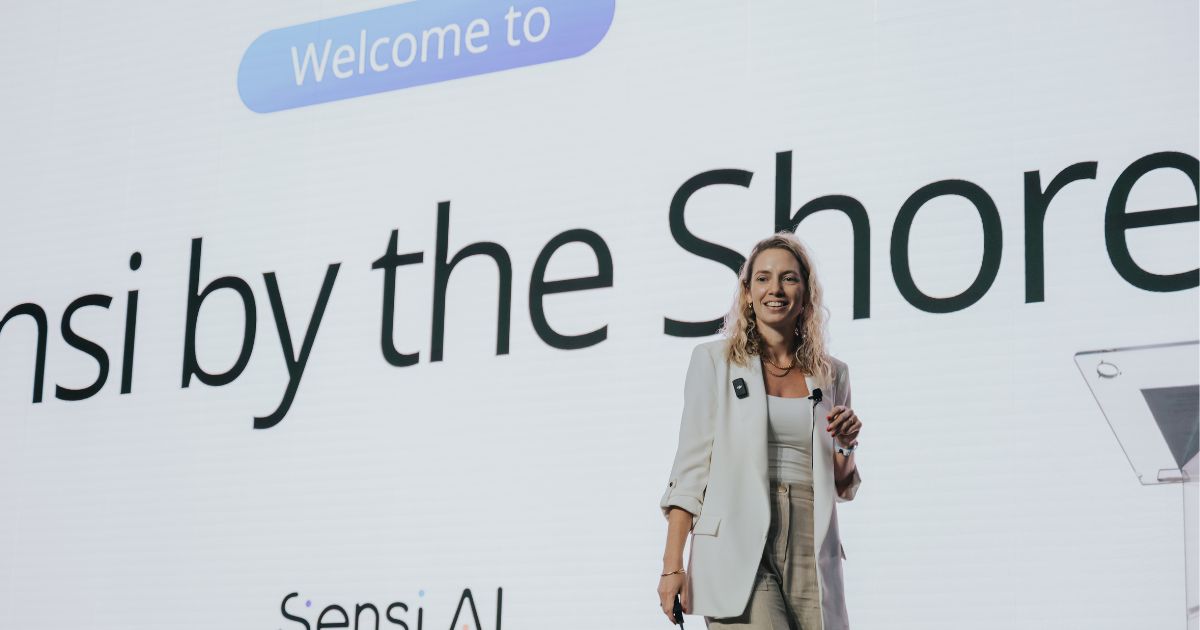
Sensi.AI founder and CEO Romi Gubes on the senior care crisis, care intelligence, and what seven years of real-world audio data teaches you about keeping seniors safe.
Before Sensi, I was a software engineer, working at Fortune 500 companies. I knew I would build my own company one day, but I didn’t have a mission worth fighting for.
Then my daughter’s daycare handed me one.
She was a toddler. We discovered abuse at the facility. I got her out the moment I realized something was wrong, but that haunts me, because for every parent who catches something like this, how many don’t?
That question wouldn’t leave me alone. I started thinking about everyone who’s vulnerable: children, people with disabilities, the elderly; people whose safety depends entirely on whether adults around them are paying attention. Most of the time, we aren’t. We’re at work, we’re across the country, we’re asleep.
So here’s the question I couldn’t shake, the one that became Sensi: How do we keep the people we love safe when we aren’t around to protect them?
Why isn’t the state of senior care, a state of emergency?
As I thought about the vulnerable, I kept coming back to senior care. The numbers alone should have caused a state of emergency: a projected caregiver shortage of 151,000 by 2030 and 355,000 by 2040. This problem isn’t a future problem. The shortage is now and it’s accelerating.
The questions that followed were important but they didn’t have good answers.
Ninety percent of seniors want to age in place. How does that square with a system where a single fall: one bad morning, one wet floor, one moment of dizziness, can end someone’s independence forever? How will an aging population afford care when costs outpace everything? And the one that stopped me cold: how do caregivers deliver quality care when they have zero visibility into what happens inside a senior’s home between visits?
That last question has a short, though not easy, answer: they can’t.
A caregiver arrives, does their job with skill and compassion, and leaves. Everything that happens after: a medication missed, a behavioral shift, a night of broken sleep, the earliest warning signs of a UTI is invisible. It stays invisible until it becomes a crisis. Then someone calls 911. Then there’s an ER visit, a hospitalization, and a conversation that families dread.
The entire architecture of senior care is built around reaction. Not prevention. Reaction.
And what that means in practice is a normalized binary: give up your independence and move to a facility, or stay home and accept a system that only responds to emergencies, not prevent them. Families were choosing between losses.
That was the lightbulb moment. A sudden, clarifying realization.
The problem wasn’t a shortage of caregivers who cared. It was the absence of continuous intelligence. No one in the home care had real-time, actionable information about what a senior actually needed before it became a crisis. Without that, even the most dedicated caregiver is at best, flying blind. And we had decided, as a population, that this was acceptable. It isn’t.
Proactive care is the baseline. And building it became my mission.
The market had answers. None of them were good enough
I looked at what the industry had already built and found it lacking. Wearables detected falls after they happened, and only if the senior remembered to wear the device. Remote patient monitoring tracked vitals but demanded regular input from the very person least equipped to give it. Check-in apps required action from a population already navigating cognitive decline and physical limitation. In care, friction isn’t a minor inconvenience. It’s the difference between a caught problem and a catastrophe.
Cameras offered visibility at too high a price. For a population already grieving the slow erosion of independence, a lens in the bedroom is a surveillance system. The dignity of aging in your own home shouldn’t require being watched.
Every solution shared the same fatal flaw: it captured a moment instead of a pattern, demanded something from the senior, or traded privacy for oversight. The industry had spent years building tools optimized for ideal patients in ideal conditions. Seniors don’t live in ideal conditions. They live in reality and that was left completely unaddressed.
Audio AI changes the equation entirely. The model is trained exclusively on care-relevant events, which means no ambient personal content passes through, only clinical insight. They didn’t retrofit HIPAA compliance after the fact. It’s built into the architecture from the start.
What the home care industry was sitting on and couldn’t see
Every hour of every day, a senior’s home is generating a signal.
How they move through a room. How they sleep. How often they cough. Whether they call out and no one answers. Taken together, these sounds form a continuous, evolving picture of someone’s physical and emotional state. It’s the baseline that shifts when something is wrong, often days before a crisis surfaces.
No one was reading that signal. The entire home care industry was sitting on an ocean of information with no way to interpret it.
Care intelligence provides that interpretative layer. It’s continuous, AI-powered insight into a senior’s physical, cognitive, and emotional well-being, derived from audio data in the home. In the most literal sense, it is what home care has always been missing. It’s a way to know what is happening between visits, not only what a caregiver observed during one.
Audio AI trained not on generic sound libraries but on thousands of hours of real home care environments can do what nothing before it could: deliver continuous, passive, privacy-preserving insight without asking a single thing of the senior. In practice, that means surfacing early signs of UTIs, medication errors, falls, calls for help, EMS activation, pain management issues, and caregiver-client incompatibility. That is a fraction of the more than 100 distinct insight types the platform surfaces, each one representing a crisis that didn’t have to happen.
The team had to match the problem
Building something at this level of complexity required a team whose expertise matched the problem’s depth and whose tolerance for unsolved hard problems matched mine. Cofounder Keren Etkin, creator of TheGerontechnologist.com and author of The AgeTech Revolution, brought a deep, research-grounded map of the aging technology landscape at a moment when most people were still debating whether the market existed at all. CRO Alon Brener had spent his career in regulated industries where trust isn’t assumed, it’s built transaction by transaction, outcome by outcome. CTO Nevo Elmalem had spent years building signal-processing and machine-learning systems designed to perform in exactly the conditions where most AI fails: noisy, unpredictable, real-world environments where the cost of error isn’t an unhappy user, it’s a missed crisis.
What 7 years in the room actually teaches you
Building clinical precision into an AI model is more than a data engineering problem. It is a judgment problem and judgment cannot be automated. It has to be learned.
A senior coughing twice in the night means something different from a senior coughing forty times. A long silence in a home with a social, active client means something different from the same silence where the client typically sleeps. The model doesn’t just detect events. It weighs them against an individual’s established baseline. That distinction is the difference between an alert that saves a life and a notification someone ignores.
We built Sensi from the ground up. Care intelligence is embedded in thousands of agencies, inside tens of thousands of homes, over seven years. Nurses, social workers, physical therapists, and occupational therapists worked alongside our engineers at every stage of model training. They analyzed thousands of hours of data, annotating what mattered and what didn’t, teaching the model to distinguish a fall from a dropped object, a cry for help from a conversation with the television. That process, repeated across a dataset now comprising over 1,000 years of real-world audio, produced a model with a 90% accuracy rate in identifying care-relevant events. The 90% figure exceeds industry benchmarks for comparable detection technologies.
This is why audio-based agentic AI in senior care is categorically different from AI applied to logistics, finance, or any other domain where the subject can be reduced to a transaction. Care is human, unpredictable, and deeply contextual. You cannot replicate that with synthetic data, surveys, or claims data. You have to be in the room.
Proof proactive care is already working
Sensi is now trusted by 80% of the largest home care networks in the country. Our clients include Home Matters Caregiving, Right at Home, Visiting Angels, Griswold, Comfort Keepers, and Always Best Care.
The outcomes don’t require interpretation. Hospitalization rates have dropped from the 54% PACE program baseline to 18% in year one of a pilot. Length-of-service increased by 50%. Clients with histories of repeated ER visits went months without a single one. These numbers are possible when caregivers stop flying blind.
We’ve raised $98 million from investors including Insight Partners and Qumra, and Business Insider, Forbes, and CNBC have recognized the documented outcomes in the field. But VC funding and business press aren’t the point.
The point is the question I started with: How do we keep the people we love safe when we aren’t around to protect them?
Seven years of data. A thousand years of audio. Tens of thousands of homes. We have a working answer and we are building on it every day.
It’s continuous care. And it changes everything.
FAQs
What is care intelligence in home care?
Care intelligence is continuous, AI-powered insight into a senior’s physical, cognitive, and emotional well-being, derived from data collected passively inside the home. Unlike traditional monitoring tools that capture isolated moments. Care intelligence builds an evolving picture of a senior’s baseline and detects meaningful deviations before they become a crisis. In practice, care intelligence surfaces early warning signs of UTIs, medication errors, fall risk, cognitive decline, pain management issues, and emotional distress, often days before a clinical event occurs. It is the interpretive layer that home care has historically lacked: a way to know what is happening between caregiver visits, not only what was observed during one.
Why is senior care considered a reactive system rather than a proactive one?
Senior care is reactive by design because it was built around caregiver visits, not continuous oversight. A caregiver arrives, delivers care, and leaves. Everything that happens in the hours or days between visits — a medication missed, a behavioral shift, a night of broken sleep, the earliest signs of a UTI — is invisible to the care team until it escalates into a crisis.
How does audio AI work in senior home care?
Audio AI in senior home care works by continuously analyzing sounds inside a senior’s home to detect care-relevant events and behavioral patterns. Small, discreet devices capture ambient audio, which is processed by AI models trained specifically on home care environments, not generic sound libraries or clinical datasets. The model learns each senior’s individual baseline: how they typically move, sleep, communicate, and go about daily routines. When something deviates from that baseline: unusual coughing patterns, a call for help, signs of a fall, medication confusion, the system generates an alert for the care team. Critically, the model is trained to distinguish care-relevant signals from ordinary ambient sound, meaning no personal conversation content is processed or stored. HIPAA compliance is embedded in the architecture, not added afterward.
How accurate is Sensi.AI in detecting care events at home?
Sensi’s audio AI platform has a 90% accuracy rate in identifying care-relevant events in the home. It’s a figure that exceeds industry benchmarks for comparable detection technologies. That level of precision is the product of seven years of model development, with nurses, social workers, physical therapists, and occupational therapists working alongside engineers at every stage of training. The model was built on a dataset comprising over 1,000 years of real-world home care audio, annotated by clinical professionals to distinguish meaningful events like a fall, a cry for help, signs of a UTI, from ordinary ambient sound. The model does not just detect events in isolation. It weighs them against each individual’s established behavioral baseline, which is the distinction between an alert that prompts a life-saving intervention and a notification that gets ignored.
