
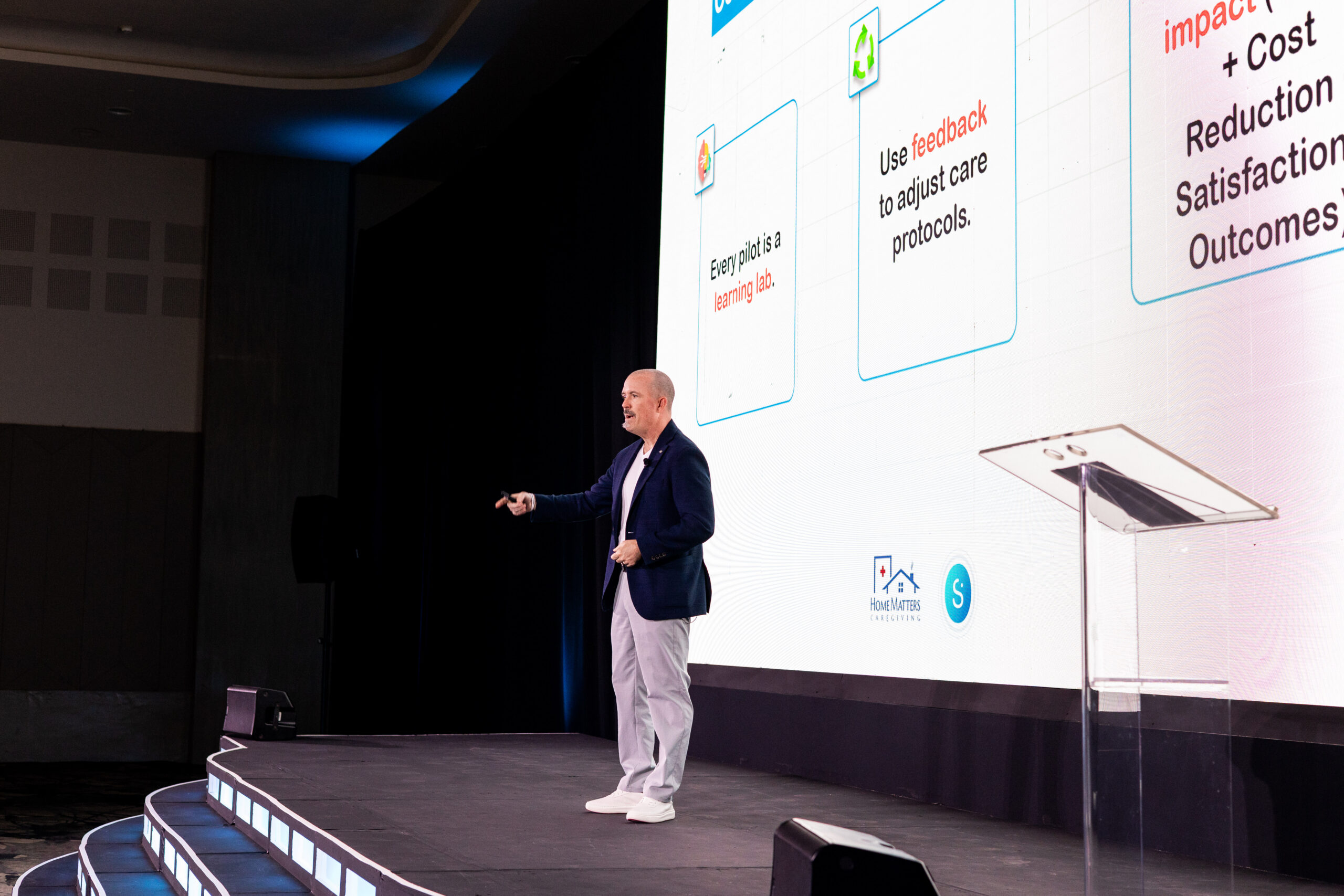
For most home care agencies, government-funded care programs can seem prohibitive. The bureaucracy is challenging, the sales cycle is long, and the standard pitch rarely moves the needle with institutional payers. Clay Foutch, founder and CRO of Home Matters Caregiving, a home care franchise organization (with 33 franchise locations) based in Beaverton, Oregon, learned this quickly. What he discovered is data insights and the right technology can open doors.
In a pilot with a government-funded healthcare model, Clay’s agency improved care outcomes and demonstrated the impact of adopting AI-powered virtual care for all participants. Using Sensi data, his agency secured exclusive referrals, avoided an estimated $450,000 in combined hospitalization and ER costs, and established a revenue stream that did not exist three years ago.
What is PACE, and why does it matter for home care agencies?
The Program of All-Inclusive Care for the Elderly (PACE) is a government-funded healthcare model for individuals aged 55 or older who have chronic illnesses and need nursing home–level care. Using a capitated payment system (per participant payment system), PACE supports keeping seniors in their communities for as long as possible. It serves the most medically and economically fragile seniors, a population where proactive, data-driven care has the most impact.
PACE is a fast growing program. From 2024 into 2026, PACE expanded to 202 programs across 33 states and the District of Columbia. For agencies ready to do the work to get into the program, PACE expansion represents a business opportunity.
The Pilot: Patience, data, and a willingness to go first
Home Matters Caregiving was 100% private pay when Clay and his wife founded it in 2007. To pursue government-funded care, Clay spent time meeting with the local PACE program administrators before winning approval for a pilot in 2023.
PACE shared objections familiar to any agency owner who has tried to partner with enterprise organizations: “We have a lot of folks that already do what you do.” “We won’t pay for this.” Clay’s response was to reframe the conversation around cost savings rather than cost expenditure. For a per participant payer program like PACE, reducing hospitalizations is a key performance indicator that reflects both care and financial goals.
The pilot launched October 1, 2023, tracking two metrics: hospitalization rates and ER visits. Frustratingly, participant growth was slow to pick up: three participants in the first quarter, five more in the second quarter. Then the pilot’s data began to tell a story.
“That family’s physician and the PACE program said, ‘There’s not a doubt in our mind that we avoided a very expensive hospitalization.’”
“We had somebody who talked about having shortness of breath and we intervened, and that family’s physician and the PACE program said, ‘There’s not a doubt in our mind that we avoided a very expensive hospitalization,’” Clay recalled. A client with congestive heart failure received medication intervention without a hospitalization. A UTI was caught before it escalated to an ER visit. Case by case, the data started building a picture.
The numbers that changed everything
By the end of the pilot, 33 participants had been served. The results, calculated using the same CMS (Centers for Medicare and Medicaid Services) risk formula PACE uses to track their goals, were striking.
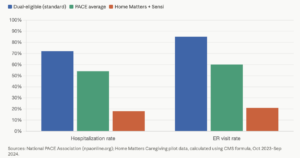
Among seniors who qualify for both Medicare and Medicaid (dually eligible), PACE already reduces hospitalization rates from 72% to 54%. The Home Matters Caregiving pilot, which utilized Sensi as its standard of care, lowered that rate further to 18% and reduced ER visits from a baseline of 85% to 21%.
“PACE looks at this and says there is something good happening.”
PACE conservatively calculated that the pilot with 33 clients saved approximately $350,000 in avoided hospital stays and $100,000 in avoided ER visits over the year. “It is a small sample size,” Clay says. “Thirty-three is not 300; 33 is not 3,000. But with 33 over a year, PACE looks at this and says there is something good happening.”
From pilot to revenue stream
Although the Home Matters Caregiving pilot fell short of its initial 50-participant goal, the clinical and financial outcomes for the 33 enrolled was a resounding success. In light of these results, PACE has expanded the program into a second phase and approved a third phase to provide Sensi to rural participants.
Home Matters Caregiving serves these 33 participants averaging 38 hours of care per week at a $39.07 reimbursement rate. The pilot created $2.5 million in revenue that, as Clay puts it, “did not exist on September 30th, 2023.” His projection for 2026: serve 75 to 90 PACE participants. That would translate to $7 million in government-funded revenue.
“Sensi care data allowed us to open up real growth.”
Home Matters Caregiving use of Sensi differentiated their services and provided insights that prevented hospitalizations and ER visits. Of the six home care liaisons at their PACE program, three now exclusively refer participants to Home Matters Caregiving because of the Sensi care data. “If you want to be different, you actually have to be different,” Clay said. “Sensi care data allowed us to open up real growth.”
What other agency owners can take from this
Clay’s PACE case study is replicable, but it requires a shift in how agencies use technology. Sensi is more than a caregiver support tool. The clinical data in its care reports is speaks the language government programs understand: outcomes, cost avoidance, and documented trends.
The strategy maps to three moves any agency can make.
- Define metrics that matter to the payer. For PACE it was hospitalization and ER rates. For a hospital system it might be readmission rates. Provide data that maps to PACE’s priorities.
- Commit to the process. Clay spent time meeting with administrators before the pilot launched. Government-funded partnerships reward consistency, documentation, and patience.
- Publish what you learn. Home Matters Caregiving plans to co-publish a white paper with their PACE program and share findings with the National PACE Association. This guide would provide all 200+ programs access to the data-informed model.
The potential for growth with PACE is immense. If you are interested in establishing yourself as a provider, you can use data to set your agency apart and validate your program’s effectiveness through a strategic pilot.
Want to grow your agency using Sensi? Contact us.
FAQ’s
What is the PACE program and how does it work with home care agencies?
PACE (Program of All-Inclusive Care for the Elderly) is a government-funded model that provides comprehensive medical and social services to seniors aged 55+ who need nursing-home-level care but want to remain in their communities. Home care agencies can apply to become PACE service providers, receiving capitated monthly payments in exchange for delivering home care as part of a coordinated care team.
How does Sensi reduce hospitalization rates for seniors?
Sensi’s AI-powered virtual care detects early signs of health changes: shortness of breath, behavioral shifts, bathroom visit frequency before they escalate to emergency events. By alerting care teams to intervening issues in real time, agencies can coordinate with physicians and family members proactively, preventing the hospitalizations and ER visits that drive up costs for payers like PACE.
How can a home care agency get started with government-funded programs like PACE?
Start by visiting the National PACE Association to find programs in your state. From there, the path requires credentialing, relationship-building with liaisons, and, as Clay Foutch’s experience shows, a differentiated value proposition that produces measurable care outcomes. Home Matters Caregiving has proven that technology like Sensi provides the data layer necessary to make that case.
