
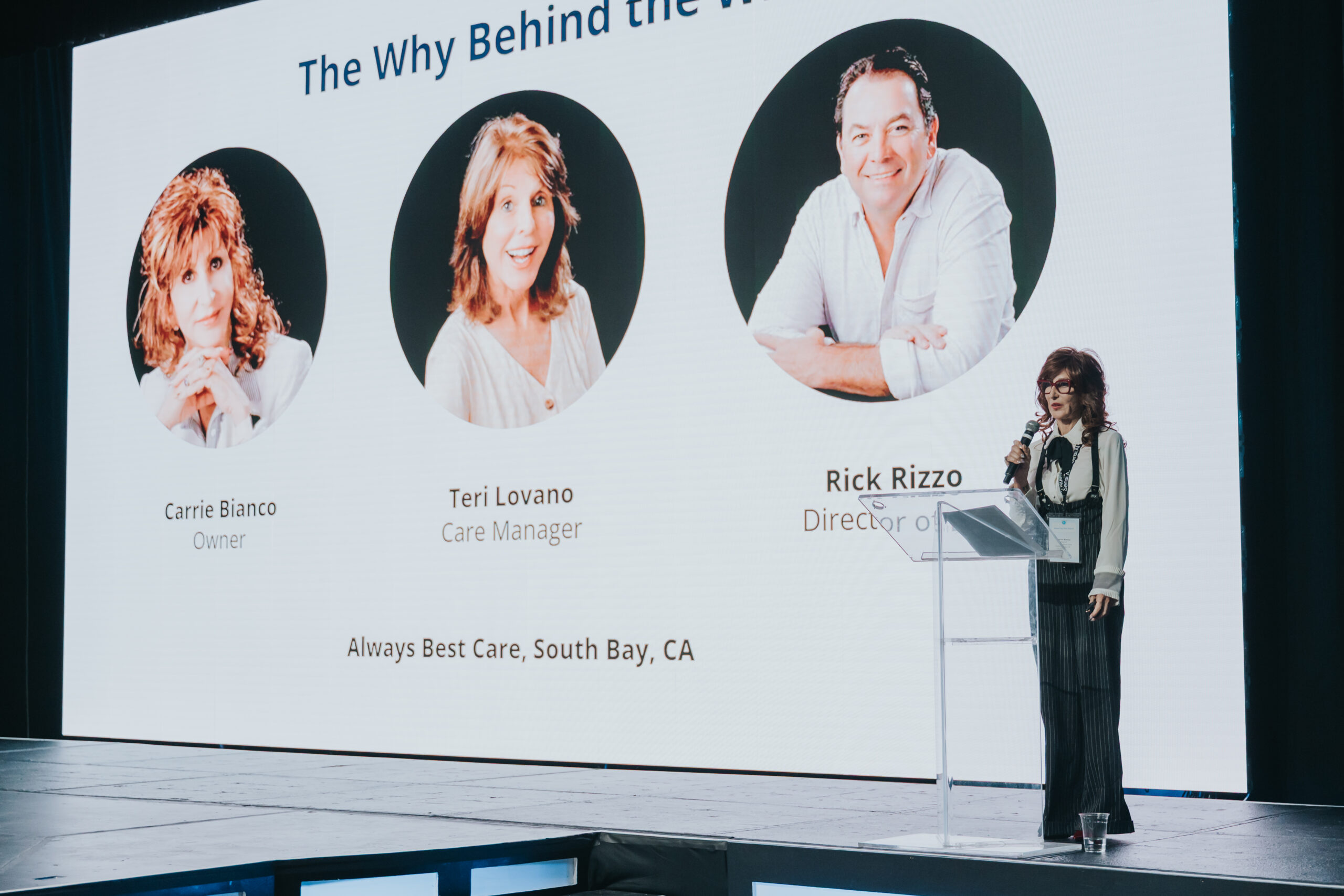
At the November 2025 Sensi By the Shore event in Cabo San Lucas, Mexico, leaders in senior home care and facilities gathered to discuss the future of senior care, industry trends, agency leadership, and technology solutions powered by AI.
Among many memorable talks, one of the most resonant was by Carrie Bianco, owner of Always Best Care South Bay, and her colleagues, Terri Lovano and Rick Rizzo. In a deeply personal session, Carrie and her team shared how a commitment to family and the adoption of cutting-edge technology paved the journey from family caregiver to multi-million dollar agency owner.
A mission to serve seniors, rooted in personal history
Personal history brought Carrie to her life’s mission, ensuring the last years of life are comfortable for every senior.
Aging guardians—her aunt and uncle were in their seventies, and their daughter, who would become Carrie’s mother, was forty years her senior—raised her. Living with her family, she witnessed firsthand the “beauty of being around older adults” and the decline that can follow.
The motivation, the “why,” behind her agency stems from gaps Carrie observed while advocating for her mother during a five-year battle with Alzheimer’s. “It was so devastating to see this independent woman… lose her memories,” Carrie recalled. After a series of failures in the traditional care system, from an eviction she didn’t know was possible from an assisted living facility to caregivers leaving her mother unattended, Carrie vowed to change the course of the final years for other families.
“I realized then that if I could do anything to…change the…course of the last five years of somebody’s life, then I want to do that.”
In a heartbreaking anecdote about her mother, Carrie shares that she entered her mother’s room on Easter Sunday to find the bedsheets suspiciously perfect, without a single wrinkle. For a fleeting moment, she hoped for a holiday miracle: “Maybe she’ll recognize me today.” But as she leaned in, her mother’s skin was cool to the touch. When Carrie asked the caregiver when she had last checked the room, the woman offered only a silent, motionless stare. Then Carrie saw a single tear roll down the caregiver’s face. At that moment, she confronted a singular, cold truth: her wonderful mother had died alone.
This is a memory Carrie will always carry with her: “I realized then that if I could do anything to…change the…course of the last five years of somebody’s life, then I want to do that.”
Scaling through innovation and diversification
Following this mission to serve seniors wasn’t always easy, and as other home care entrepreneurs will attest, getting into home care brings steep learning curves. For Carrie that included a misstep that would affect her agency’s finances.
It was during this moment of peak professional stress, that she discovered Sensi. Sensi could not help Carrie with her business setback, but the technology reminded Carrie of her “why.” Upon hearing her first demo of a Sensi audio alert, featuring a senior in distress, Carrie didn’t ask about the return on investment; she asked, “Where do I sign?”
It’s this type of care and enthusiasm for supporting seniors that Carrie brings to running Always Best Care South Bay. For Carrie, adding Sensi to her arsenal of care was a rare instance where the demands of the heart aligned with business goals.
After implementing Sensi in 2024, her agency has seen explosive growth, including:
- Client base: Expanded from 100 to 270+ clients.
- Revenue: Grew from $6 million to a projected $8.6 million.
- Diversification: Leveraged technology to secure contracts with UCLA Longevity Center and LA County Human Services.
Real-time clinical impact: Terri Lovano’s perspective
Terri Lovano, supervisor of care management at Always Best Care South Bay and a career gerontologist, got onstage and shared how Sensi alerts provide a safety net for her team. Sensi allows caregivers to spend more quality time with clients, acting as a backup, offering insights that families can use to make critical care decisions.
“At least Sensi got him to the hospital.”
She shares a critical incident where Sensi detected a client had dangerously low blood pressure. “I called the son. I’m like, ‘what’s going on?’ Dad’s blood pressure was like 60 over something,” Terri recounted. When the family hesitated to go to urgent care, Terri took charge: “I said, ‘Why does your Dad have a say so in the matter? Hang up, call 911.’” The client spent four days in the hospital before returning home successfully. “At least Sensi got him to the hospital.”
In the high-stakes environment of geriatric crisis, Sensi serves as a “dispassionate observer,” offering data when families are too overwhelmed to see clearly.
Breaking down doors: Rick Rizzo on growth and Sally
While Sensi functions as a 24/7 partner for a blended care strategy, it also eliminates bottlenecks that delay care. Rick Rizzo, who leads growth for Always Best Care South Bay, noted in his talk that Sensi’s Sally acts is a growth agent that acts as entire inside sales team by making appointments for care assessments, even on weekends. It often ensures a family in crisis gets an assessment days faster than they would otherwise.
After Carrie brought him onstage, Rick mentioned that Sally provides him with much-needed peace of mind by managing his schedule and “making appointments for me for the following week.” Beyond automating the initial care assessment, Sensi serves as a differentiator that “breaks that door down” with medical professionals. Using Sensi has become a competitive advantage that has secured Rick referrals from neurologists and rehab centers that had previously ignored his standard pitch.
“Working with your heart and all that stuff was kind of a foreign concept for me.”
Rick also shared the story of a client with high-acuity needs who was only under the agency’s care for a month. Despite the short time, the senior felt a deep connection to Rick because he took the time to visit him in the hospital. When the client eventually passed away, Rick discovered that the man had left something for him in his will. “Without Sensi I don’t think I would have ever met this guy,” Rick admitted. “The whole heart and… working with your heart and all that stuff was kind of a foreign concept for me… but yeah you just can’t help but get close to these seniors.”
Takeaway
The team at Always Best Care South Bay: Carrie Bianco, Terri Lovano, and Rick Rizzo, represents the gold standard in senior care. Though they arrived in the industry through different personal and professional paths, the numbers show their collaborative approach improves the senior experience while driving business growth.
Their agency has moved beyond the traditional model of simply hiring and supporting caregivers. They’ve shown Sensi is truly a standard of care. And, as a consequence, they’ve created a robust support system that delivers superior outcomes for seniors, provides peace of mind for families, and offers critical assistance to frontline staff.
If you’re inspired by the work that Carrie, Terri, and Rick are doing for our seniors and want to learn how Sensi can support the critical work you’re doing. Contact us for a demo.
FAQ’s
How does AI technology improve senior home care?
AI technology, like Sensi, acts as a “dispassionate observer” that monitors for clinical risks 24/7. It can detect audio cues of distress, identify physical trends (like increased restroom use), and alert care managers in real-time, ensuring seniors are never truly alone even when a caregiver is in another room. For home care agencies, it works as an effective backup for a blended care strategy.
How can AI help scale a home care agency?
As demonstrated by Always Best Care South Bay, AI helps scale agencies by diversifying service offerings and increasing efficiency. By implementing Sensi, the agency grew its client base from 100 to over 270 and increased revenue from $6 million to a projected $8.6 million in just one year.
What is Sensi's "Sally" agent and how does it help agencies and families?
Sally is an AI-driven growth agent that calls potential clients to schedule care assessments. It automates calls, even on weekends, shortening the time it takes for families in crisis to book appointments. Families can now book a care assessment exactly when their loved ones need one, decreasing the time it takes to get a caregiver to help in their home.
